In 1845, a fungus was carried by ship from North America to England. This fungus is known as Phytophthora infestans, a fungus that makes crops rot and turn black. It made its way to Dublin, Ireland, a country that relied on potatoes to be the main source of food for 8.8 million people. Farmers in the west of Ireland found their crops turned to black because of the fungus, they rotted from the inside and had a strong displeasing smell. This caused the Great Famine of Ireland, the worst famine in Irish history by having their main source of food being invaded by a foreign fungus.
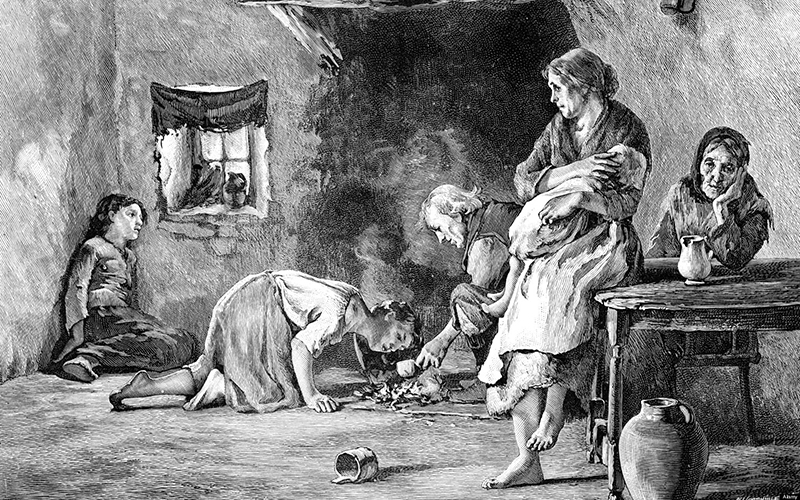
The Irish Famine, 1845-1849, painter unknown.
This unfortunately, caused a lot of Irish families to die, men, women, and even children. Approximately 1-2 million people died due to starvation, even with the aid from England by sending ships filled with corn from America to Ireland. In addition to this, Irishmen couldn’t be employed by the strict British policies towards the famine. They had no way of income, and couldn’t rely on a crop that was so important in their lives. Their only option was a change of land, a new income, a new opportunity. This opportunity was to emigrate to the United States, a country that was exploding in technology, a free country that had economic abundance was safe for them.
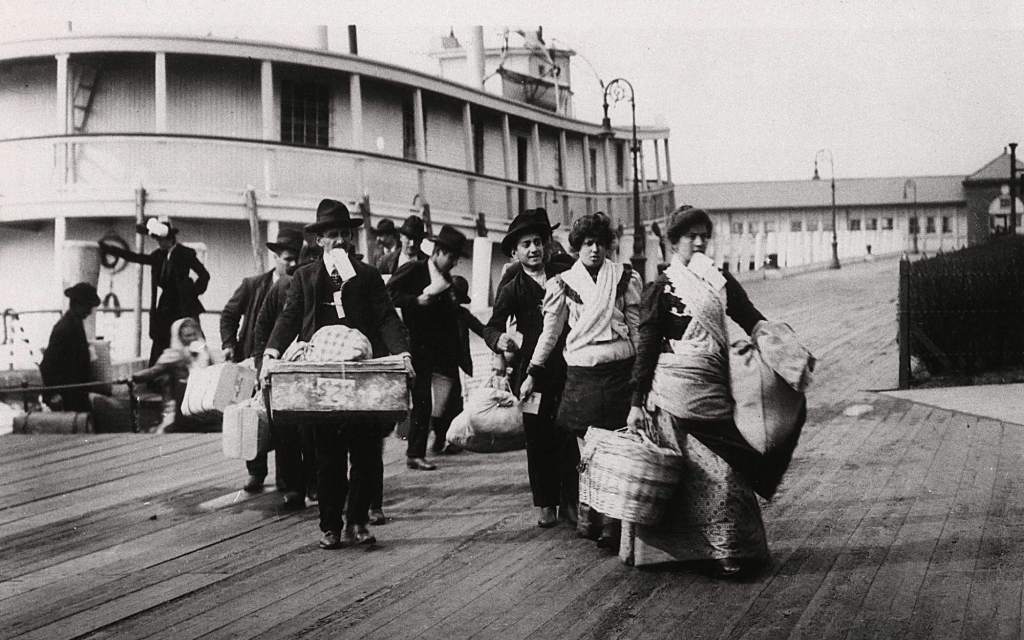
The journey from Ireland to the United States was a disastrous one. More than 17,000 deaths were recorded of passengers trying to cross the Atlantic, it was a risk that 2 million Irish families took in order to reach a country that gave them a chance to survive. Irish immigrants were mainly concentrated in urban cities, in Northern states like New York or Boston. They settled their own communities with other Irish immigrants, they had their own food, music, and culture. It was like their home in Ireland, in a distant land growing in the 1850s. However, they weren’t greeted by welcoming hands by their neighbors.
Irish immigrants faced nativism by Americans who feared they would take over American jobs and “erase” American culture . Political parties like the know nothing party, was popular for their nativist beliefs and anti-immigration, mainly on the Irish. This party had great support from Americans who were hostile towards immigrants, and this had bad influences on the social perspective on Irish immigrants. Political cartoons like “The Usual Irish Way of Doing Things” by Thomas Nast, a political cartoonist, drew this cartoon to spread the anti-Irish sentiment. They were seen as people with no manners, no religion, and were violent. This affected their economic opportunities as well.
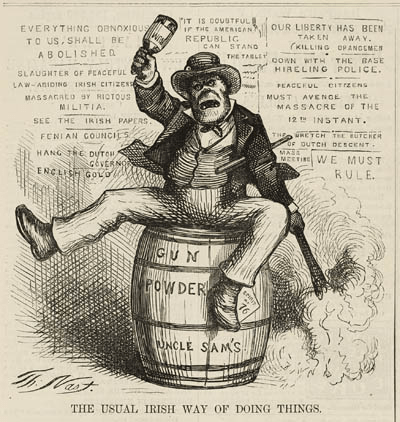
“The Usual Irish Way of Doing Things” Thomas Nast, 1871.
Businesses in large urban cities had a “No Irish Need Apply” policy. Meaning that Irish immigrants were excluded from good paying jobs, and were forced to work in low paying jobs like working at a factory for long hours. In the 1800s, factories were known for its lack of safety guards for the workers, the machines were loud and dangerous, and the workers had no type of safe equipment. Irish immigrants had to earn money to survive, but at what cost? Instead of dying of starvation, they ran the risk of dying in a foreign factory, in a place they didn’t belong but had to endure, because its community hated their race of immigrants. Even with these hardships, they boosted the American economy by their labor, and were part of building American infrastructure like the transcontinental rail.
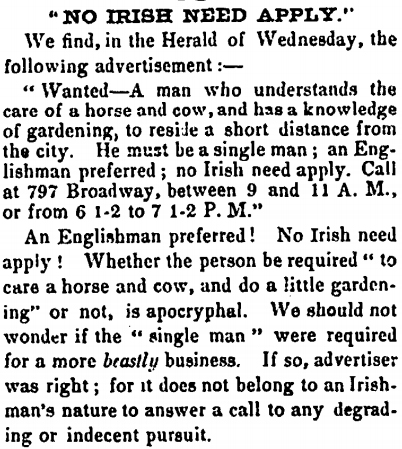
Piece of a New York newspaper , 1850s
The Irish were hated and Americans wanted to do nothing with them. Some of the Irish decided to join militias, or try to bargain their way in the army to find a fair wage. But when the American Civil war started in 1861, those Irish immigrants in the army were ordered to fight. The army was their only way to find a wage, but now they were forced to fight a war, in a country that hated them from the beginning. A famous character for the Irish immigrants in the army, was general Thomas Francis Meagher. He was known to be an Irish nationalist, but he’s famously known to be the commander of the Irish Brigade. A Irish-American infantry unit composed by the 63rd,69th, 88th of New York, and then later on the 28th of Massachusetts and the 116th of Pennsylvania. They were known for their green flags, representing their Irish heritage, and also their battles at Marye’s Heights and Wheatfield. The Brigade was known for their courageous stand off in bloody battles, standing up and fighting with honor.Meagher believed that Irish immigrants had the opportunity to fight for the land they now called home, but also to show Americans they cared about the U.S.
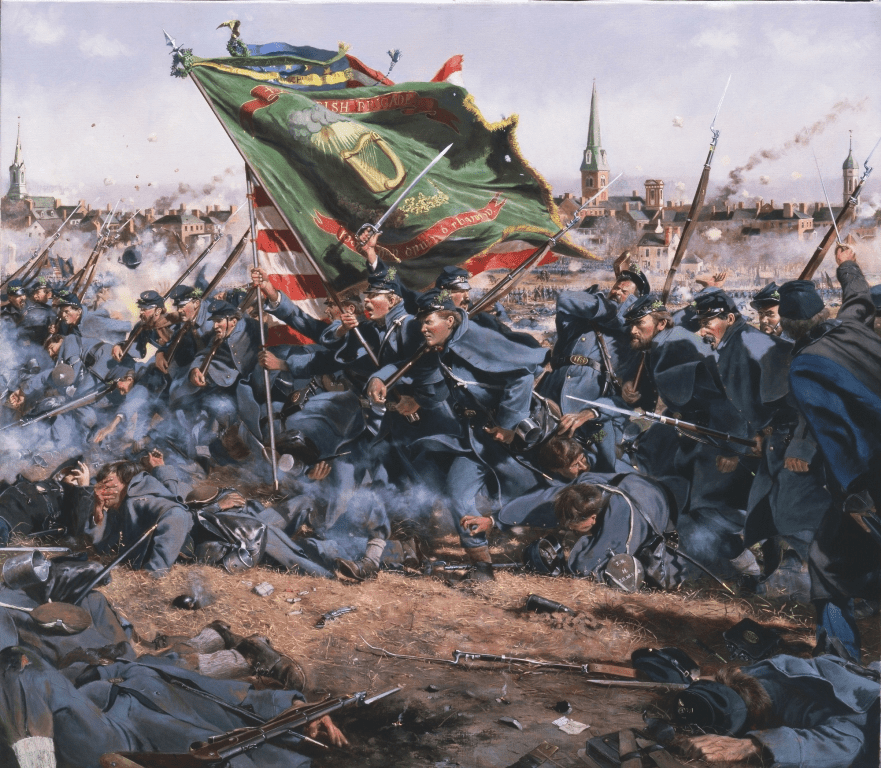
The Irish Brigade at Gettysburg, 1863
Irish immigrants escaped a famine, hoping for a land of peace, but were met with racism. Were limited in the social and economic ladder, and some of them fought for their land in the Civil War.But even so, Irish immigrants earned their keep and were noble to the very end. Signifying that even when a group of people are hated, their actions show a whole different character.
 In the Margins
Leave a comment