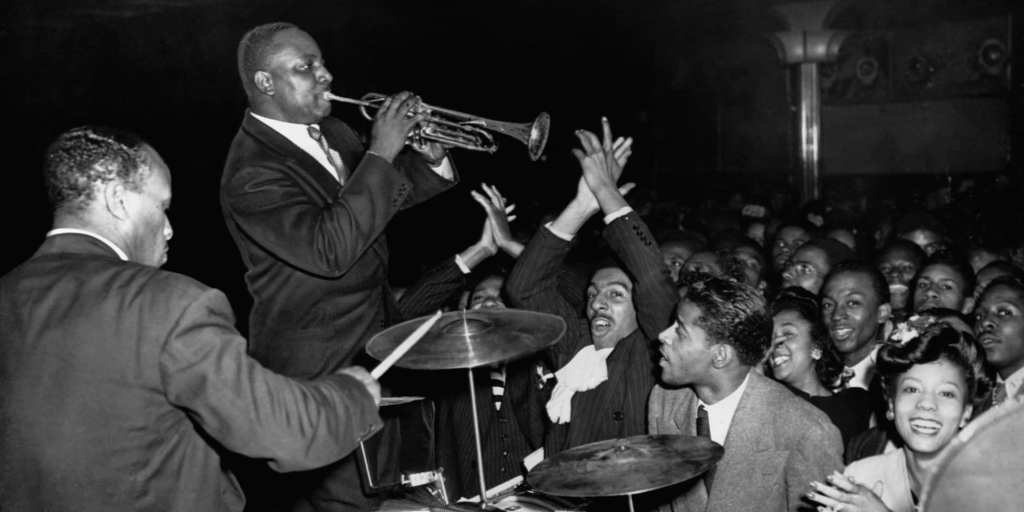
Cootie Williams plays with Duke Ellington at a ballroom in Harlem, 1930s
After the American Civil war ended in 1865, congress passed multiple laws to integrate African freedmen and freedwomen to American society. Laws like the civil war amendments (13th,14th,15th), gave them the right to be free and no longer slaves, to be called a citizen of the United States, and their rights not be forbidden by anyone in the states. The South however, adopted new ways to suppress the new African Americans citizens, on their rights. The practice of sharecropping on farms for example, made poor Black Americans rely on white farmers for payment and food, racist groups like the KKK killed and forced African Americans to vote for white leaders, and jim crow laws were passed to segregate public spaces for whites and colored only.
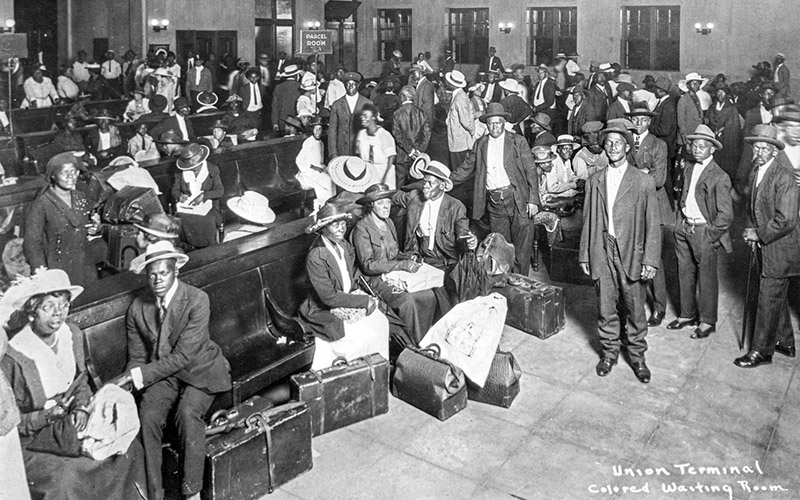
Black Americans at Union Terminal Jacksonville, Florida. 1921
After a whole war was fought over the dispute of slavery, racism was still present, and they were still taking away their rights. This caused later on the years to a movement called the great migration, a migration of ten thousands of African Americans from the South to the North. They did this to find jobs in the new factories in Northern cities like New York, but the main reason was to escape the cruelty of the south. They wanted to make something of their own, something artistic so that the creator and others can enjoy some place where they can express themselves without getting judged, to be human. Alain Locke was a Black American writer that expressesed this in his anthology “The New Negro” in 1925, “…the Negro community is bound to enter a new dynamic phase,” this phase that he was talking about was the Harlem Renaissance.
The Harlem Renaissance was a cultural movement in Harlem, New York during the 1920s-30s. This was a result of the Great Migration stated before, Black communities moved to urban areas looking for new opportunities. Aside from that, they created Black communities mainly in Harlem to change the culture and identity of the Black American. One way it was achieved was through the expression of literature.Writers like Langston Hughes showed challenging ideas towards segregation in his poem “I, Too” by saying “They send me to eat in the kitchen When company comes,” he decides to use this to show how even eating, has become a practice that has been twisted by the selfishness of whites. But later on, he says “ Tomorrow,I’ll be at the table When company comes.” representing his bold stand against segregation, that he’s human and has the right to stay. He then ends his poem by stating “I, too, am America.” Hughes was a writer that was born in America, that he was a citizen by law, by land, the only thing that was different was his color of skin. This type of literature made the Harmlen renaissance effective within Black communities, to show the common sense that Black Americans have the right to be free, to enjoy life and to be proud to be a Black American.
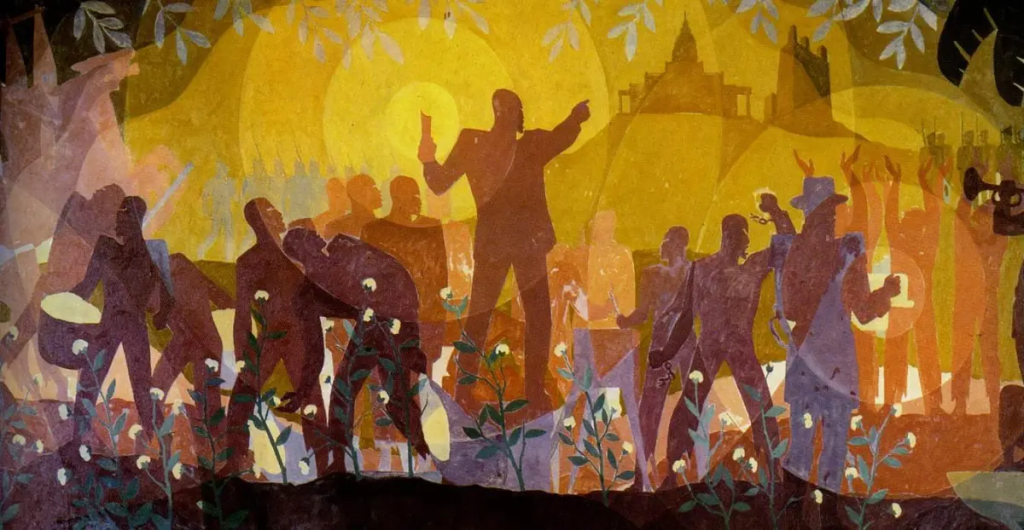
Aspects of Negro Life : From Slavery Through Reconstruction, 1934. Aaron Douglas
Visual arts were one of the iconic ways that Black artists expressed their pride. Painter Aaron Douglas shows the past, present and future for African Americans in the United States. Paints like the Aspects of Negro Life – From Slavery Through Reconstruction, shows how Douglas uses the past of African Slaves picking cotton, their present was that they were free from bondange, but their new way of life was still being oppressed. In the background, there’s buildings on the hill, a trumpet playing with the people cheering, signifying their future, brighter days than their dark past. Douglas is known for his paintings that show challenges towards segregation, and reminds the Black community about the injustice they endured. But that they have the opportunity, the opportunity to create a new identity by their own choice. Paintings like these are composed of colorful colors and
Music like jazz was also used for Black expression during this period. Musician Duke Ellignton was more notable by his rising popularity, he was known through his creative piano playing. He started in the popular night club based in Harlem, the Cotton Club. His orchestra was known to play at any tempo, any type of style, but Ellington had one thing in mind. “I am putting all I have learned into it in the hope that I shall have achieved something really worthwhile in the literature of music,” music is a worldwide practice that’s expressive, that can be enjoyed by the composer, the musicians, and the audience. For Ellington, music was the best way to make something for the Black community to enjoy, something they created and can be able to take the credit of building on their own. He won 14 Grammy awards, got his name on the Duke Ellington School of the Arts, and he’s still looked as one of the leading faces on the rise of jazz in the United States. Duke Ellington’s career shows how the expressive art of Black Americans, has become an important part of their culture and has become their identity.
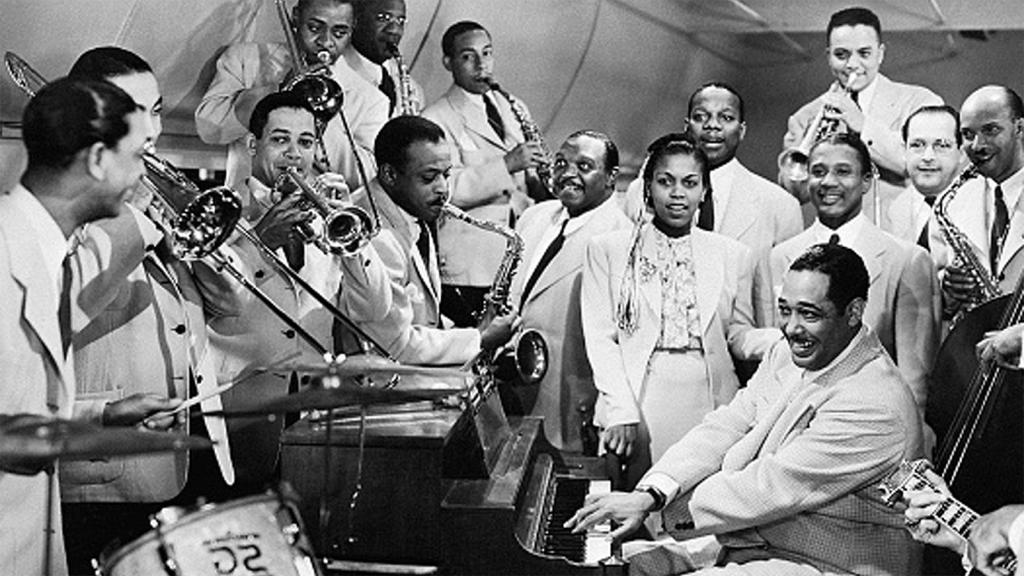
Duke Ellington with his orchestra in the film Reveille with Beverly, 1943
But, there was a group of Black Americans that argued that art was not enough to change the social problems. One of these leading voices was from W.E.B Du Bois, he published a series of newspapers called The Crisis. These newspapers showed the unseen violence and injustice that Black Americans faced, that even though Black artists were getting popular, their equality was never seen. Du Bois believed that civil rights was the only way for Black Americans to truly gain their equality.
The Harlem Renaissance was an important milestone for Black Americans. It was an expressive period that left the space for the civil rights movement later in U.S. history to come to life. Their art was beautiful and expressive, their identity was determined, but it left the hole of inequality opened. With this art movement, the civil right movement in the 1960s had a firm foundation thanks to the Renaissance.
Sources
- https://www.easternct.edu/news/_stories-and-releases/2021/03-march/vp-stacey-close-outlines-a-history-of-the-great-migration.html
- https://www.americanyawp.com/reader/22-the-new-era/alain-locke-on-the-new-negro-1925
- https://www.poetryfoundation.org/poems/47558/i-too
- https://www.kennedy-center.org/education/resources-for-educators/classroom-resources/media-and-interactives/artists/douglas-aaron/
- https://thecharnelhouse.org/2014/08/03/afrofuturism-aaron-douglas-and-w-e-b-du-bois-1920s-1930s/aspects-of-negro-life-from-slavery-through-reconstruction-1934-aaron-douglas/
- https://www.kennedy-center.org/education/resources-for-educators/classroom-resources/media-and-interactives/media/music/duke-ellington–harlem/
- https://modjourn.org/journal/crisis/
- https://www.history.com/articles/harlem-renaissance
 In the Margins
Leave a comment