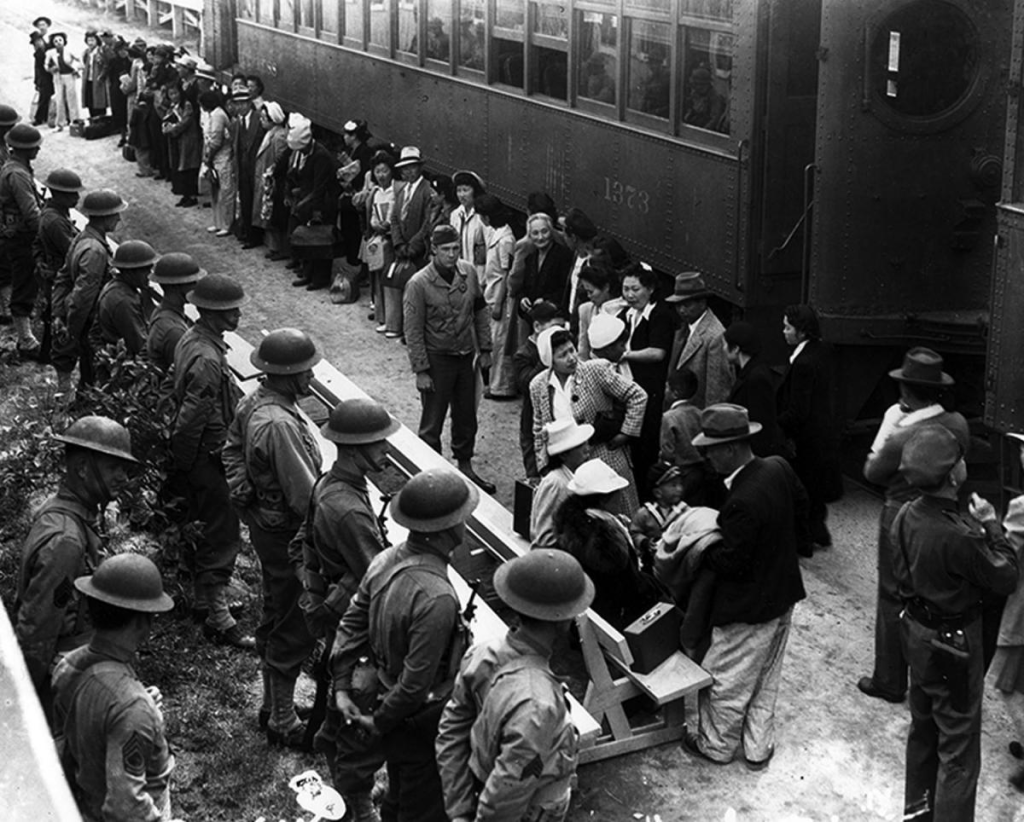
(Boarding trains for Manzanar Relocation center,1942)
In the year 1941, the world was at war. Germany and Italy had conquered most of Central and Western Europe, so the U.S. decided to remain neutral. But on December 7th at 7:48 am ,Pearl Harbor was attacked by the Japanese Kamikaze. Multiple ships were destroyed, 2,403 American lives were taken, and the country was pushed to make a choice, join the war. Franklin Roosevelt asked congress to declare war on Japan in order to defend themselves soon as possible. On December 8th 1941, the U.S. would officially join WW2 alongside the allies.
In this event, Americans became hostile against the Japanese, but also have fear of Japanese Americans. Media like the Los Angeles Times spread fear and hatred to the public towards the Japanese with accusations of espionage and rebellion. With this growing fear, the U.S. would take away their citizen’s freedom and deny them of their civil rights.
Franklin D. Roosevelt passed executive order 9066 on February 19 1942. An order to forcefully move Japanese aliens with or without citizenship to detention camps. The order said “I hereby authorize and direct the Secretary of War… to take such other steps as he may deem advisable to enforce compliance. ” The government used this to justify their actions to preserve their security, but there was no evidence to back up that Japanese Americans were a threat.
The government would send out notices to make them move out of their homes and go to special train stations, making them lose their way of life and be treated like criminals.
When the Japanese arrived at these camps called “assembly centers” they were met with poor conditions. Some of them were built near swamps, in deserts and even places where horses used to live. “And just seeing the living arrangement was, it was a real bummer. Thinking that, wow, this room has one light bulb,” Aiko Herzig-Yoshinaga shared how life really was in these barracks. They were cramped together, with poor beds, poor sanitation and also suffered harsh winters and endured sandstorms, they were stripped of their privacy and had no comfort. They had to wait in long lines for food, making them rely on the place that’s keeping them there. The camps were protected by guards that mistreated them, the fences were barbwired; making them feel like true criminals.
Despite these conditions, the Japanese tried to make a sense of living. The WRA (War Relocation Authority) made schools, gave jobs to volunteers to maintain a better quality in the camp, and even had their own newspaper like the Manzar Free Press or the Topaz times to inform the detainees about daily events. They also had recreational events for the kids and even made furniture for their barracks. But even so, they still felt imprisoned, charged with something they didn’t commit, they felt betrayed. “Down in our hearts we cried and cursed this government every time when we showered with sand. We slept in the dust; we breathed the dust; we ate the dust.” Joseph Kurihara shared how they truly felt about the government, their freedom taken away from them in the land of the free.
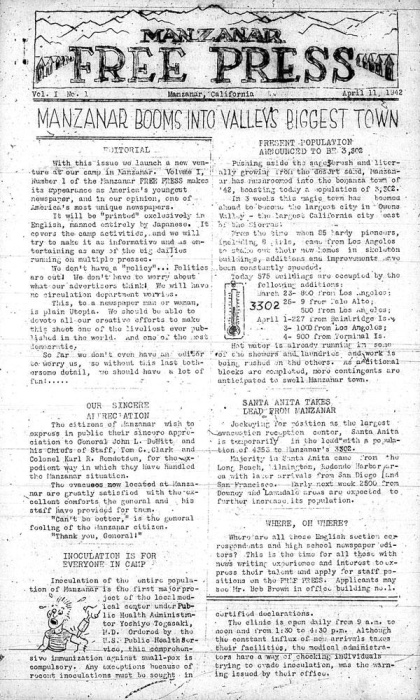
(Manzanar Free Press was a newspaper published by Japanese Americans in the Manzanar relocation camp,1942)
But there were some that challenged the government in the court, they fought for their freedom but also for the Japanese American’s freedom. On May 30, 1942 Fred Korematsu was arrested by the FBI for failure to report to a relocation center, he was convicted of disobeying military orders but he was represented by the American Civil Liberties Union to be his defense. He was found guilty in a federal court in San Diego, but his attorney decided to appeal to the U.S. court of appeals, but also found that Korematsu did in fact violate military order. He decided to ask the supreme court to look over his case. On December 18,1944, the court ruled a 6-3 decision that the relocation was justified with “military necessity”.
But this was different in the case of Mitsuye Endo, a Japanese American born in Sacramento, CA. When she was relocated to a detention camp, she pleaded a habeas corpus with the argument that she was a loyal citizen and never went to Japan or even spoke Japanese in 1942. The WRA decided to let her go since they did not have the power to detain citizens with no charges. But the district court ruled they couldn’t let her go since it would create an imbalance in the migration supervision. She appealed to the U.S. supreme court to review her case, in 1944, she was then released from her detention camp since the court saw her as a loyal citizen. This shows the U.S. was contradicting itself, with the same year, two different individuals but the same situation.
After the war ended in 1945, Japanese Americans were released from the camps but the damage was already done. Their homes were occupied by other people, their jobs moved on and they were scarred for life with the trauma they went through for years. In the country that was fighting for freedom, they took it away for the Japanese with no real reason.
 In the Margins
Leave a comment